The Rescue Story
The leading story throughout the whole of Current Archaeology is undoubtedly rescue. Before Current Archaeology, archaeology was essentially research archaeology. The professor researched a problem, a site was chosen, a team was assembled and the professor spent his summer holidays solving his problem by successful research excavatiom. But then in 1970, this was changed. It suddenly dawned on archaeologists that archaeology was being destroyed everywhere, all around them. Not only in town centres but by deep soil ploughing by the building of motorways, digging of quarries and even by afforestation. Should we not do something about this?
The alarm was raised at an annual get together of extramural tutors in archaeology held at Barford in Warwickshire. Here, in 1970, Philip Barker, the extra-mural tutor for an archaeology for Worcester and ace excavator at Hen Domen and Wroxeter, wrote a paper entitled ‘Not waving, just Drowning’ in which he fired everyone up. Another conference was held and eventually and in 1971 a grand meeting was held at Senate House in London with over at 500 people attending. The atmosphere was amazing: it was like a religious meeting when we were all fired up and resolved to abandon our ‘sun drenched hilltops’ – a favourite term – to work down in the muddy trenches of rescue archaeology. A new organisation called Rescue was born.
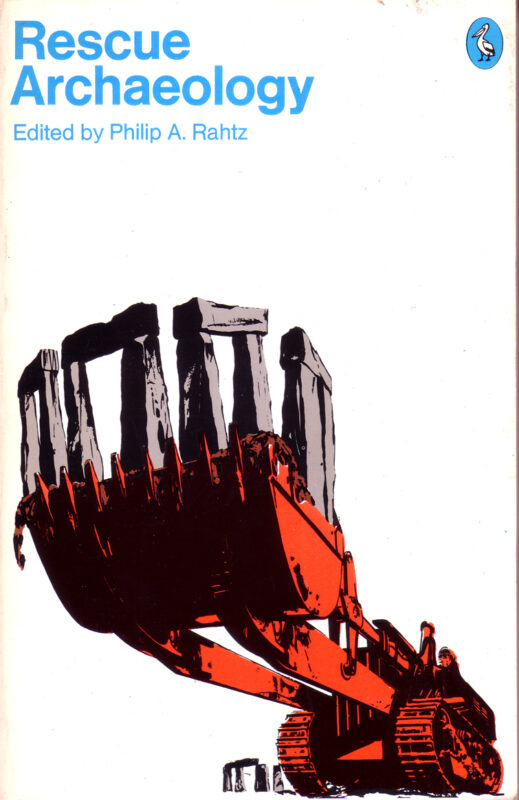
Everyone went home inspired. In the early days of Rescue, everyone tried to build on the existing structures, with ideas for raising funds. Many local societies set out to rescue the local archaeology, some of them succeeded, many were overwhelmed. University lecturers saw the opportunity to carry out research on Roman towns which were being redeveloped.
A number of local units sprang up where people went on to devote their lives to the town: one thinks of Philip and Nina Crummy at Colchester finding the Romans Circus, or Mick Jones at Lincoln. Gradually the government in the form of the Ministry of Public Buildings and Works was drawn into supporting the work with extremely modest payment for a few lucky excavators who received payment for lodgings during a dig – though no payment for writing up. A few survived.
An unexpected source of funding for archaeology came with the Manpower Services Commission set up by the Heath government in the 1970s to provide work for the unemployed. Archaeologist sniffed a source of funding and a number of schemes were set up. A lot of earth was shifted and the scheme proved very useful for the unemployed as archaeology provided real work – something with which they were not always accustomed. But there was no payment for writing up, so the scheme eventually fell out of favour with archaeologists. An example I remember was Peter Scott at Piercebridge (CA 220) who was a highly successful newspaper proprietor in Lancashire who retired and went to Durham University to write a thesis quietly with Rosemary Cramp but he was lured into doing a small dig but he was a very efficient organiser and perhaps unexpectedly he soon found himself employing 50 unemployed people, getting up at 7:00 o’clock every morning and working till 5:00 o’clock to supervise them – not what he wanted to do in his retirement so he was not unhappy when the scheme ended.
Money from the government steadily increased . This was aided by an inspired example of publicity concerning the Houses of Parliament themselves. A new underground car park was dug out under the outer courtyard, much to the convenience of MPs, but no major excavation was carried out in advance. What a scandal! Here were the MPs destroying their past without any investigation. The MPs replied in the usual way by loosing the purse strings and throwing money at the problem. The amount of money available for excavation raced ahead. The truth seemed to be that no campaign was needed: the palace yard had always been open ground – there was no archaeology there apart from a fountain at the centre which was properly recorded: the pubicity was more than a little naughty – but it worked.
English Heritage
In the 1980s and 90s (Margaret Thatcher 1979 – 1990) the government funding for archaeology was totally changed by two major initiatives. The first was the founding of English Heritage by Michael Heseltine as an independent quango. The government had acquired a large portfolio of ancient monuments which were all hived off to an independent body under the inspired leadership of Lord Montagu. There had previously been a system of season tickets to enable free entry to the monuments, as I remember (perhaps wrongly) there are only some 5,000 of these, but Lord Montagu, who was a marketing genius set about enlarging it and by the time he retired, English Heritage had getting on for 100,000 members. Indeed Current Archaeology benefited because we did a Christmas leaflet advertising with their magazine which over half a dozen Christmases more than doubled the subscriptions to Current Archaeology.
But should the government pay for rescue archaeology? Should not developers pay for the destruction they were doing? The concept was pioneered by Brian Hobley, who had been appointed Chief Urban Archaeologist for the Guildhall Museum. Development in London was roaring ahead and Brian persuaded developers that archaeologists could be a nuisance but the best way of warding them off was by paying for excavation on the understanding that the archaeologists got off site by an agreed fixed date.
Brian was very persuasive and this worked well in London: but could it be transferred to the rest of the country? Geoffrey Wainwright the chief archaeologist of English Heritage found the answer in what became known as PPG 16 that is Planning Policy Guidance note number 16. This was a ‘guidance’ issued to local planning authorities, saying that archaeology should be taken into consideration when giving planning permission for new developments. It wasn’t law but ‘guidance’ but guidance was enough, and ever since, if you want planning permission for development, you must do the archaeology first.
As reported in CA 162, PPG 16 had been simmering throughout the 1980s: an early version had been pioneered in Berkshire where Paul Chadwick the county archaeologist was working them out with Paul Gosling then Inspector of Ancient Monuments for Berkshire. Mike Griffiths was also exploring similar ideas in North Yorkshire. The first draft of PPG 16 was written in 1986 by Mike Parker Pearson and Graham Fairclough, both of the time inspectors working in Fortress House.
At first, Geoffrey Wainwright judged at the time was not yet right and told them not to show to the DoE but to hide it away in the bottom drawer. Then in 1990, when the Rose Theatre affair blew up and the DoE was desperate for a new policy, Geoff was able to dust off the document which was promptly accepted. Jane Sharman, the then Chief Executive helped rewrite it, and it was launched in November 1990.
I didn’t hear about PPG 16 when it was first issued. It sort of crept out and I was either asleep or there was a feeling that somehow I wouldn’t approve and it would be best if I was no overtly informed about it. Certainly there were elements that went against my beliefs, but it did indeed solve the rescue problem by transferring payment from direct government to payment by the developer. It was a hidden tax but well hidden and from the pragmatic point of view it has worked well. Similar devices seem to have been adopted in many countries around the world, I don’t know whether by direct imitation or how far the concept of making the developer pay was a miasma whose time had come.
The bedrock of the system was the division between curators and contractors, the curators being the archaeologists employed by the planning authorities who advised the planners, whereas the contractors were the units who actually carried out the work and were employed by the developers, so the developers could see that the people they pay for the work were quite distinct from the ones who advised the planners. This meant that there was constant competition between the units in bidding for work, which meant that theme there is competition to see who could bid the lowest and therefore do the least work. In practice this is not happened as the curators have been able to enforce minimum standards and lay down how much work is done; but unfortunately it has pushed down the pay of the actual diggers in the units.
There was a great struggle to persuade local authorities to employ the ‘curators’ who could make PPG16 work but once employed a main task was to build up a database of all the finds in their area even if these only amounted to a couple of sherds of pottery or struck flints so that when a developer wanted to erect a new supermarket, the curator could consultant their database to have some idea as to whether archaeological work should be done.
Far more visible were the units that sprang up to do the actual archaeology. These are entirely independent bodies, some limited liability companies, the majority being charities. These have become huge and powerful; the big three, Wessex, Oxford and MOLA, the Museum of London Archaeology, all have more than 300 staff including not only excavators but also substantial staff to do the writing up, often quite separate from those who do the excavation. Indeed all the best pottery experts and small finds enthusiasts are to be found in the big units.
In addition there are large numbers of specialist expert advisers, often the leaders of the units you have got rheumatism in their knees (the archaeologists disease!) and need to ‘retire’ and set about advising developers how to get round PPG 16. They are the intermediaries who negotiate how much work should be done : for the most part they do a splendid job. (I sometimes contrast archaeology with natural history where those who deal with bats in the belfry or with badgers with TB, (Natural England) seems to allow demands that are quite excessive.)
Between them English Heritage and PPG 16 have reformed archaeology, I suppose you might say in a Thatcherite formula. However, English Heritage has now been split up with the legislative part of scheduling monuments being hived off to a new body called Historic England. English heritage continues to look after all the monuments but will no longer receive any government grant after an initial £80 million foundation grant. Whether this will work, I do not know. Surely there are many minor monuments which need to be preserved but will never cover costs. Either the government must continue to take on this responsibility or they may have to consider how to hive off some of their unprofitable monuments. We saw one example of this in Somerset where English heritage bought a property, spent a lot of money doing it up, but then sold it off on condition that it was open to the public regularly. Is this the way ahead? I do not know.
But is developer funded archaeology working? A lot has certainly been done; much soil has been shifted and many reports have been produced. In a way, the original problem has been solved. Little archaeology is being thoughtlessly destroyed. But have we lost sight of research archaeology: is all this information being used?
A major feature has been the loss of the county archaeologist. Prior to PPG 16, the majority of our historic towns or counties had a local archaeologist: one thinks of Peter Addyman at York investigating Viking York and turning the excavation at Coppergate into a spectacular visitor attraction known as Jorvik; more typical perhaps has been the work of Philip Crummy and his wife Nina at Colchester discovering the Roman circus; or the lifelong work of Mick Jones at Lincoln. They can see the history of their town as a whole, but most of them have been swept away by the onslaught of the big units who win the contract do the work, write the report and depart.
They have been admittedly attempts to provide an overall look. A fine example is John Blair from Oxford University who obtained a three year grant from the Leverhulme Trust to investigate Anglo-Saxon England and spent the three years investigating what is called the ‘grey literature’ of the period. Most rescue excavations are not published but the final report is made for the planning department and becomes grey literature’
John went round and read some 800 of these grey literature reports and as a result rewrote the story of Anglo-Saxon England, finding what he called the eastern zone concentrated around the Wash in Norfolk and Lincolnshire, where there is extensive physical evidence for archaeology, typified by Ipswich ware pottery, – an emphasis emphasised by metal detectorists who have been particularly active in Norfolk. This contrasts with earlier work which emphasises the Midland country and as John admits provides a muted emphasis on the Vikings, clashing with the place name evidence.
His investigations also showed that the classic mediaeval village does not date back to the ‘Middle Saxon shuffle’ but does not appear until the11th century’. Similar investigations are in progress for both Prehistory and for Roman Britain.
And I think I must say that Current Archaeology has been a little disappointed by commercial archaeology. It just hasn’t been ‘getting out’ – we have not got the articles from the big units that we ought to have done.
Part of the problem is that developers have been burnt by activists who invade developments and try to destroy them. It is better therefore to do all developments in secret, and often confidentiality clauses are inserted in the contracts with archaeologists. Thus the HS2 railway development has seen some spectacular engineering which they should be proud to show off but they have been keeping quiet about it, which is surely a pity.
Another part of the problem is that our market has shifted. In the early days, in the 1960s and 70s, most excavations were done by volunteers or by students and if you wanted to get diggers for your dig, you needed to advertise it, and Current Archaeology was one of the best ways of doing so. Mick Jones at Lincoln said how useful he was having an article in Current Archaeology to publicise the dig on the Roman gate.
But with developer funded archaeology, the market is different. The publicity they need is for the people who give out planning permission, the planners or the local councillors and therefore the publicity they need is in local newspapers or by inviting children to see their digs because the children will tell their parents about it and their parents may be the local councillors.
All this is important, but the local society, the local archaeological enthusiasts are left out. Admittedly we do get the occasional major report particularly on roads, but one can see the point of view for the directors of the big units that producing an article for Current Archaeology may take perhaps up to a week of valuable excavators time, and can not be justified.
Nevertheless I believe that what is called what I call the middle market is important, lying between the academics and professional archaeologists on one side and the general public on the other. Those in the middle, the members of local societies, the readers of Current Archaeology, and indeed the readers of this book who take a serious interest in the past, in the history of their surroundings and want to read about archaeology, visit sites and often to do digs themselves. I fear that with commercial archaeology as it is organised, the archaeology is not getting out. But I think they know this . . .