Germany, 1969
The next year we carried out what proved to be the most elaborate of our foreign archaeological trips when we went to Germany. It proved to be the last trip without children and we found so much material that we had to make it an extra-long issue of Current Archaeology – CA13.
I have always had a soft spot for Germany. I began learning German at school where the lessons consisted mainly of singing German songs, both the traditional versions and the Schubert versions. I then went to Germany with Nick Allen in the brief interval between leaving Rugby and joining the Army, and I lived in Germany for six months in the final part of my National Service. I have practised the language and have accumulated several German girlfriends, and I wanted to show off my knowledge of the language to Wendy.
German archaeology was flourishing, not least because at the time a church tax was added to the income tax which teachers and civil servants could not really avoid. Churches became very rich and church archaeologists took it upon themselves to help relieve them of their wealth, so church archaeology flourished. In preparation I asked Christopher Hawkes who I should approach, and he said approach Irwin Scollar at Bonn who was an inspired choice. Irwin was in fact an American who had studied at Edinburgh and had the two specialities of aerial archaeology and computer archaeology and was therefore much in demand and knew everybody. At the time Bonn was still the capital of Germany and had a splendid museum. At the very beginning of a tour, one was confronted with Neanderthal man – the real thing as the Neander valley was close to Bonn.
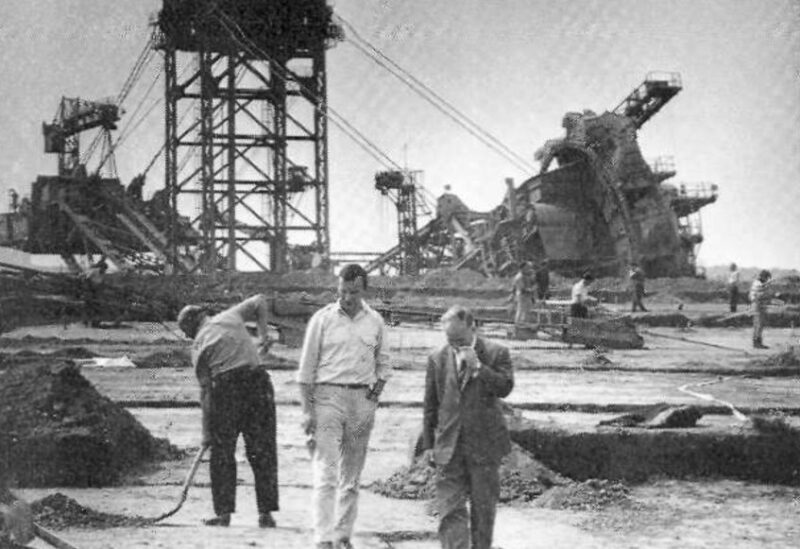
One of the things one tends to forget in German archaeology is the very rich Neolithic . This was originally discovered by Childe, who called the Danubian culture. Now, it is known as the Bandkeramik culture, or the Linear Pottery Culture in English. It features long dwelling houses and we featured one at Inden which had been destroyed by open cast mining, where each of the long houses was accompanied by a smaller long house.
The Celts
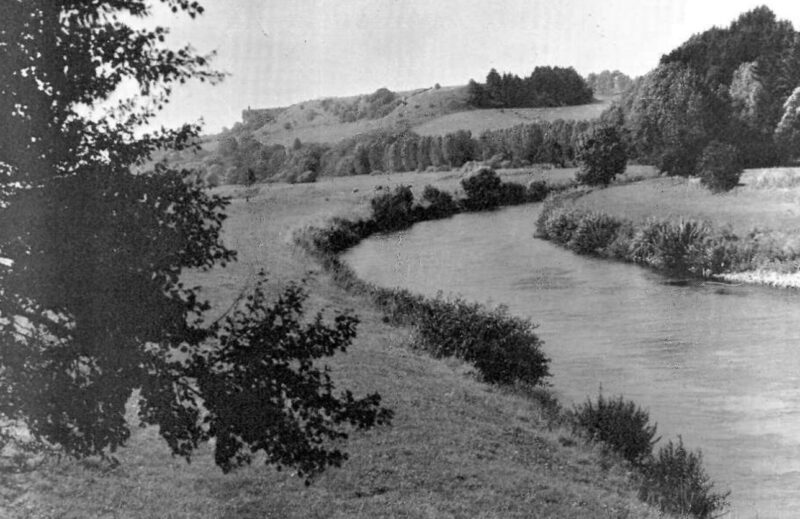
One of the outstanding features are the two major excavations of the Celts in southern Germany. The Heuneburg in southwestern Germany lies in the Black Forest on the banks of the river Danube (see image at top) . It was one of the few sites in Germany that we were able to actually visit, and it is indeed a most beautiful part of the world.
The central part is comparatively small, only 8 acres but there is a very extensive outer bailey which has been investigated since. The site was at its height from 600 to 400 BC, when Greece was also at its height and a small amount of black figured pottery was found. The big surprise came when they were excavating the fortification and found that the original timber and earth fortifications was replaced by a much more impressive mud brich wall, and it was suggested that the ruler or his son had visited Greece, and had been much impressed by their stone fortifications, and came home and determined to imitate them.
The Hirschlanden statue
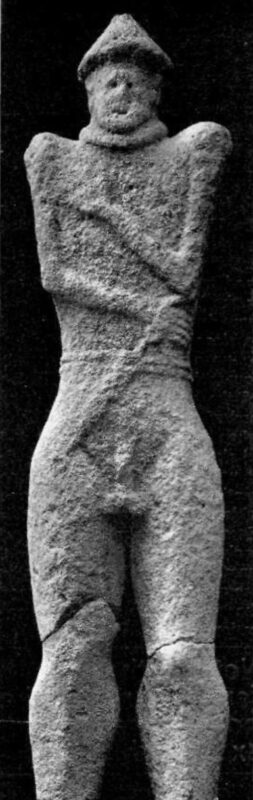
For Dr Zurn, who was in charge of archaeology in this area, the most spectacular discovery was on the first day of an excavation of a barrow when he found a life-size Celtic statue of a warrior that originally had stood on the top of the barrow. There are a number of these Celtic statues known, but this was one of the best.
The other big surprise was that there was an extensive refortification in the early mediaeval. From 600 to 800 AD, that is the Merovingian and Carolingian period, a most impressive fortification was built, in fact, the more impressive part of the defences.. Excavations are still continuing and have revealed the importance of the whole site, which became dominant in southwestern Germany.
An even more impressive Celtic site is being excavated at Manching near Munich. This is a big site which shows that the Celts were erecting what can called towns before the Romans. We were not able to visit it, but I gather that he lies under an American Air Force Base and is very impressive.
The Romans
For the Romans, Germany was frontier territory, especially in the area along the Rhine facing the Germans, and we covered three major excavated sites.
Firstly there was Neuss opposite Dusseldorf. Neuss had been extensively excavated between 1888 to 1900 but recent excavations went outside the fortress and uncovered six successive camps of the Augustan/Tiberian period, when the Rhine was frantically busy.
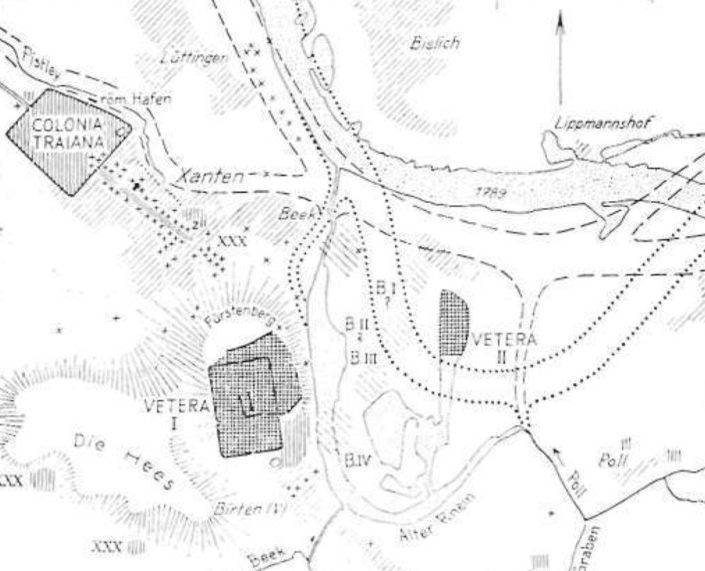
Then at Xanten, two legionary fortresses have been excavated, one double, the other single ,but the main attention has been to the succeeding Roman town, which is the only Roman town not to be covered by a modern town.
And then there was Cologne, the major settlement in Germany. Here there were two very important sites. First of all, there was a governor’s palace or praetorium, an impressive building much better preserved than the possible Roman palace excavated about the same time in London. But the most spectacular excavation was under the great cathedral where two very spectacular Frankish graves were discovered.
They were presumably royal graves, where royalty was getting the best of both worlds, being buried in a Christian church to show their Christianity, and with Frankish bling to show that they were, basically, gaudy loving Franks.
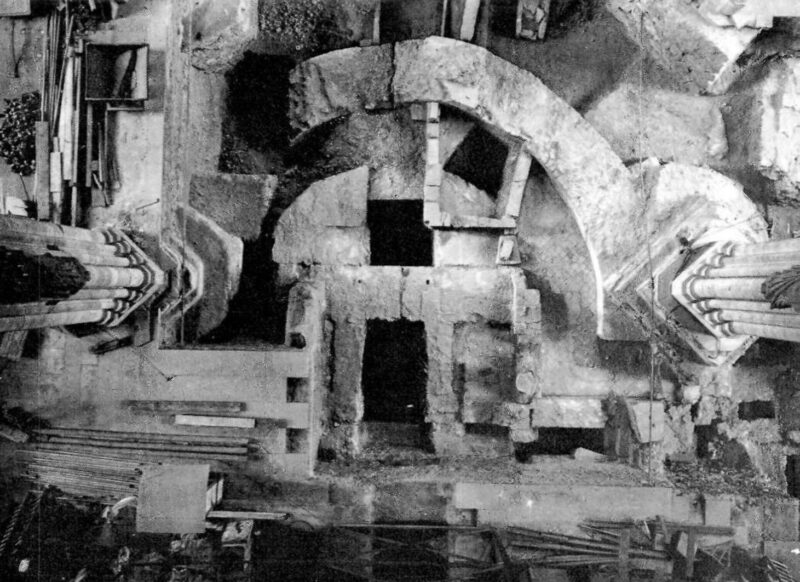
Several buildings followed including, a major Romanesque cathedral, with altars at either end leading to the fashion for having elaborate Westworks. But this was pulled down in 1248, giving way to the present cathedral which was so grand that it was only completed in the 19th century.
One should also mention the fine, well preserved example of a Jupiter column . These are specialities of Roman Germany, particularly around Trier; two were found, one of which was nearly complete and 6 metres high.
Paderborn
One of the more interesting church excavations was at Paderborn. Today Paderborn is in North central Germany – an extended outlier of the Ruhr Complex, but in the 8th century it was a border town between the kingdom of Charlemagne to the West and the fiercely pagan Saxons to the east and from 780 to 800 there was fierce fighting and the area changed hands several times.
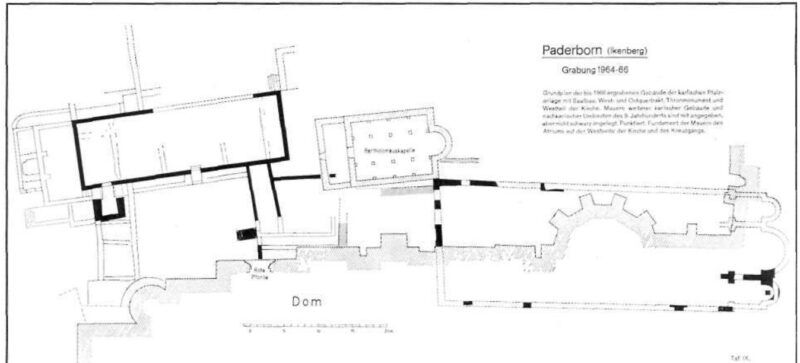
But it was here that Charlesmagne had one of his capitals. The capital city at the time consisted of two parts, the Cathedral and the Aula Regia, the Royal Hall, with a passageway between them and it was here that the major ceremonies took place.
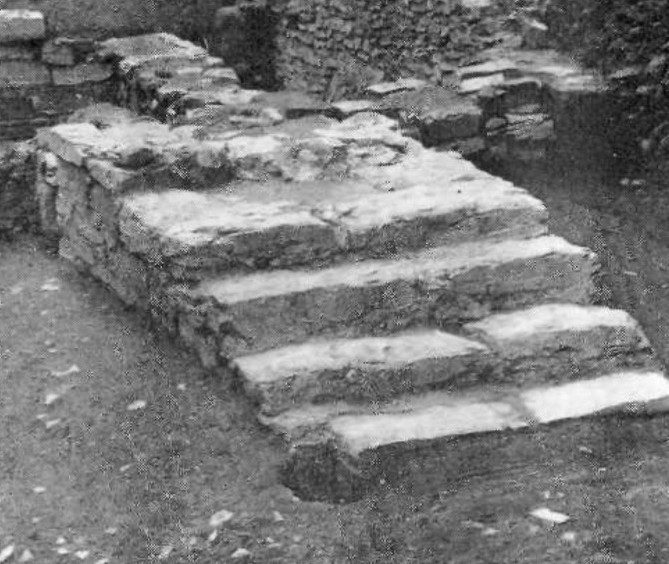
To the archaeologist’s surprise, both parts were recovered, the cathedral lying under the present cathedral, while to the east was the royal palace with walls connecting them. They also found the base of the royal Throne where in 799 Charlemagne received the fugitive Pope Leo III. The Pope rewarded Charlemagne on Christmas Day 800 when Charlemagne was celebrating in Aachen and the pope unexpectedly crowned him as Holy Roman emperor – and history was made.
Feddersen Wierde
The site that interested me most in Germany and to which I devoted the longest article was Feddersen Wierde.
Along the low lying margins of North Sea, stretching from Holland along North Germany and up into Denmark, there are a number of low mounds, on the top of which villages once perched. In Germany these are generally called ‘Wurts’ which resemble the tells of the Near East in that they are built up on the remains of former villages, but there is one major difference. Whereas the tells of the Near East essentially grew by accident as houses collapsed and new ones were built on the rubble, the wurten of North Germany were built up by design, in order to raise the villages above the level of the marsh in which they are situated, and upon which the sea has been gradually encroaching.
The date of these wurts varies considerably; some are still occupied by villages, with houses spreading out from the village green, in the distinctive radial form; but the majority appear to be Iron Age villages deserted in the 5th century when their inhabitants, exasperated by the rising sea levels, left their villages, and many groups of the population emigrated to England’s green and pleasant land.
These wurten, with their successive periods built up layer by layer, were obviously very attractive to archaeologists, an attraction increased by the damp marsh-like conditions in their interiors which preserved wood and other organic materials perfectly so that large parts of wattle walls of the houses have often survived.
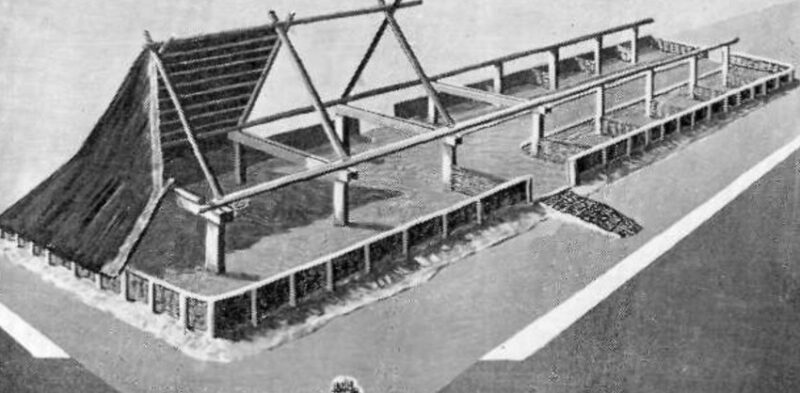
The basic form of the wurt was the longhouse, a form of building which began in Germany in the Neolithic – see the article on Inden – but it continues right down to today, with cows replaced by cars.
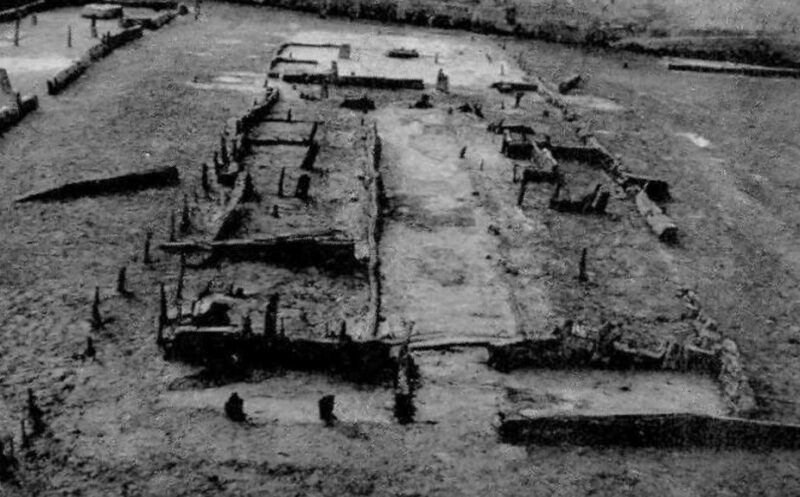
Indeed I noticed in the six months I spent in Germany during my National Service that the barracks were built in the form of longhouses, as contrasted to the English form of barracks, which are built as spiders, with individual huts connected by corridors . But each long house was accompanied by a granary, built above ground to keep the corn dry. These houses could be huge, 30 metres long, built with an aisle structure with the inhabitants living at one end and the cows at the other, – the animals acting as a sort of central heating for the whole structure.
Thanks to the build up of the different layers it was possible to work out the social structure of the wurt throughout the ages. In the first century AD they were all individual houses, each longhouse being enclosed by fence, arranged in lines parallel to each other. They began off with the houses all lying in parallel rows but gradually changing to a radial structure like houses round a village green.
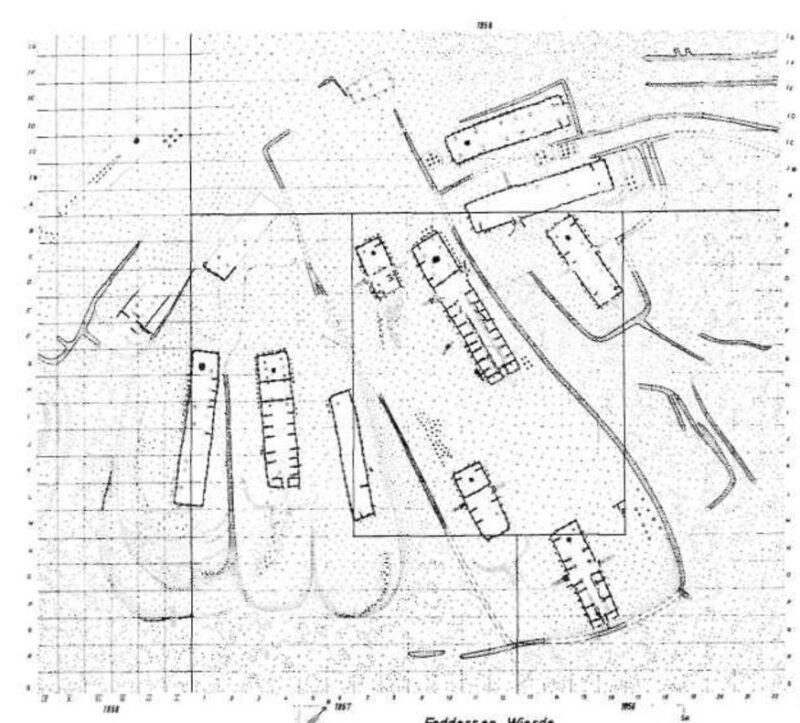
In the first century, however, differentiation began to appear. There is an interesting group of four houses, surrounded by a common ditch one of which was definitely superior with standing for 30 cows. However, at the beginning of the 2nd century it suddenly bulges to twice its size and a new house appears exceptionally well built. This house had no cows, but it appears that the owner had become so wealthy that he was stabling his cows elsewhere It looks as if the social structure of the village had changed decisively. Instead of a community of roughly equal status, we are moving into a more stratified society with one farm in the position of definitive superiority
During the 2nd Century there is the beginning of considerable specialisation . One moderately sized house consists practically of living quarters but there is a substantial granary, and the economic secret of this house was revealed by the finds, indicating that the owner specialised in the working of bone and antler.
In the 3rd Century all the individual fences disappeared and only one fence remained around the Manor house but the fundamental change was in basic economics, for a vast new industrial area was created. It was not just industry, but also a thriving import export trade with a considerable quantity of Roman material, Samian ware, beads, glass, coins and brooches. Iron smelting was also carried out but concentrated around the Manor house where the Lord could keep his eye on it.
During the 4th century, decadence set in. Granaries disappear and there was a change from arable to pasture as the rising sea water flooded the fields with salt water so they were no longer suitable for arable, though they do provide some posture for animals.
The last phase of the village dated to the late fourth and fifth centuries and show the complete breakdown. The houses are small and impoverished and in the middle of the 5th century, the village was abandoned, as the people left their homes, to look for another farming area, so they set off for a new life in the green and pleasant land of England. It has been noted that the final stage of pottery to be found at Feddersen is virtually identical to the earliest pottery found at Mucking in Essex on the banks of the River Thames – ideal farming land be taken over by immigrants. It is a sandpit now, fertile– and dry.